

.png)
Feedback first. Review second.
Ask a category manager how their products are performing on the digital shelf and you'll usually get a confident answer about distribution, share of search and price position. Ask about their review profile and the answer is less consistent - better on some sites than others...
That's a problem, because for a shopper standing in front of an unfamiliar product on a retailer website, reviews aren't a nice-to-have. They're the deciding factor.
The benchmark: 50 reviews, 3.5 stars, last 12 months
We asked 1,000 UK shoppers what a review profile actually needs to look like before it's credible enough to give them the confidence to buy a product for the first time..
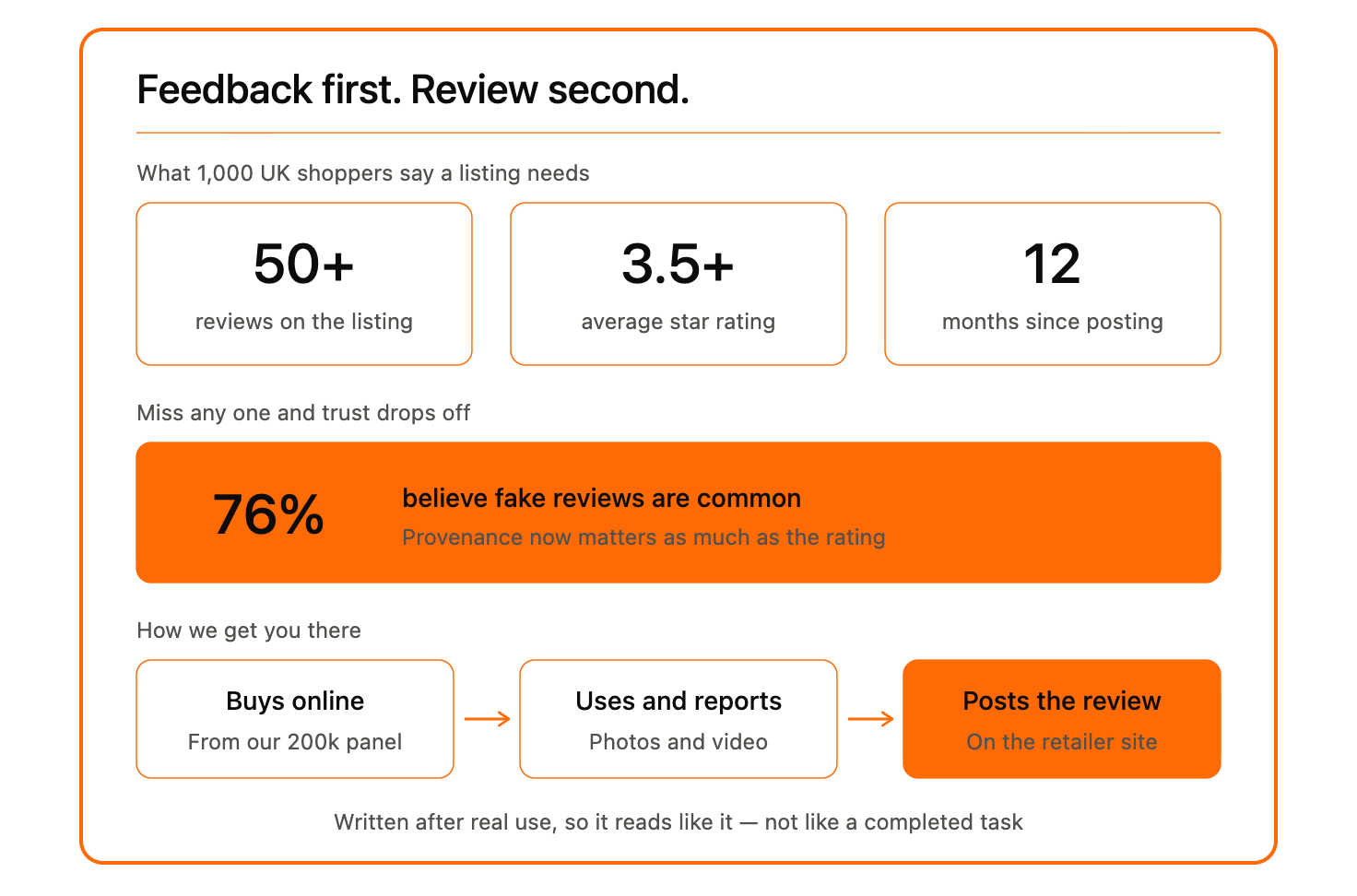
The answer was clearer than we expected: at least 50 reviews, posted within the last 12 months with an average rating of 3.5 or better. Below those metrics and trust drops off.
Miss any one of the three and the profile stops doing its job. Fifty glowing reviews from 2022 read as a product nobody buys any more. A 4.8 star average but with only 9 reviews reads as friends and family. Volume without recency, or recency without volume, doesn't convert.
And 76% think fake reviews are common
That's the more uncomfortable finding. Scepticism is now the default setting — shoppers arrive at your listing are ready to question and disbelieve what they read.
Which means provenance has become as important as the star rating attached to it. Not just what the review says, but whether it came from someone who genuinely bought and used the product.
Why this is getting harder, not easier
Brands tell us the same thing repeatedly: generating reviews on retailer and e-tailer sites is more difficult than it was two years ago.
Retailers have tightened their review policies. Incentivised reviews are being stripped out. Syndication covers some of the retail estate but leaves obvious holes — and the retailers it doesn't reach are often the ones where you're trying to establish a new listing.
Meanwhile, new product launches face the coldest start of all: a listing goes live with zero reviews, if it converts poorly, and gets marked down on availability that will lead to a poor rate of sale before it ever had a fair hearing.
How we get you there: feedback first, review second
The order is the point.
Feedback first. Shoppers from our 200,000-strong UK crowd buy your product online. They use it and report back on how it performed, with photos and video.
Review second. Having already thought through what the product actually did for them, they then post a genuine review on that retailer's site.
That sequence is why the reviews read like someone who's really been using the product, rather than someone completing a review "task". They're detailed and specific rather than three-word throwaways — which is what both shoppers and retailer algorithms reward. Your review volume builds without the profile looking manufactured.
And you get the feedback either way. The performance data, photos and video are yours whether or not a review is ever posted — repurpose the video for social, feed the product insight back into development.
The model is deliberately flexible: no subscription, and coverage across all major retailers including Tesco, Morrisons and Amazon. Brands including Spacegoods, Trip, Karo Healthcare, SC Johnson, Brewdog, Tilda Rice and Mars Food work with us this way.
Start by finding out where you actually stand
Most brands we speak to don't have a current, retailer-by-retailer picture of their own review profile. They have a general sense that "Amazon's fine" and "the grocers are patchy."
That's why we offer a free Review Audit. Send us your top SKUs and we'll come back with:
-
- Review volume and average rating for each SKU, retailer by retailer.
- How many of those reviews landed in the last 12 months.
- Which listings fall below the 50 / 3.5 / 12-month benchmark.
- Retailers where you have no meaningful review coverage at all.
- How your profile compares with the competitor products sitting alongside you.
- The recurring themes in your negative reviews — often the most useful output of the whole exercise.
- An action plan to get the scores up to benchmark.
It usually reframes the conversation. The problem is rarely "we need more reviews everywhere." It's almost always two or three specific SKUs on two or three specific retailers.
Try it before you commit to anything
The Review Audit is free and there's no obligation attached to it.
And if you want to see the review generation working before committing, we'll run a free pilot generating 10 online reviews on a product and retail channel of your choice.
Drop an email to robin@fieldagent.co.uk and let me know which of your products you'd want to look at first.